By The River Valley Capital Team ·

What Is Overtrading?
Overtrading occurs when a trader takes positions that exceed the opportunities, exposure limits, or entry conditions defined by their trading strategy. It is not simply a matter of trade frequency.
A scalper may execute numerous valid trades during a session without overtrading. A swing trader may overtrade by opening just one additional position that does not meet the strategy's criteria. The important distinction is between planned trading activity and unnecessary trading activity. For example, a trader who takes ten valid setups within predefined risk limits is not necessarily overtrading, while another who opens three positions out of frustration may already be doing so.
Overtrading is therefore better identified through rule violations and unnecessary exposure than through trade count alone.
Why Do Traders Overtrade?
Different causes require different solutions.
Boredom
Some traders feel that sitting in front of a chart without opening positions is unproductive, and they begin interpreting ordinary price movements as trading opportunities. The solution is to establish clear entry criteria and accept that some sessions may provide few or no qualifying setups.
Revenge Trading
After a losing trade, a trader may feel compelled to recover the money immediately. This can lead to larger positions, weaker entries, and unnecessary risk. A predefined stopping rule can help interrupt this behaviour before additional losses occur.
Fear of Missing Out
Watching a strong market move without participating can create pressure to enter late. However, a position entered after the original setup has passed may have a different risk-to-reward profile. Missing an opportunity does not automatically justify chasing the next price movement.
Overconfidence After Winning
A profitable session can encourage traders to increase their activity because they feel unusually confident. The same entry standards and exposure limits should continue to apply after winning trades.
Constantly Switching Strategies
When traders change strategies throughout a session, almost every market movement can begin to look like an opportunity. Limiting activity to a defined set of setups can make trading decisions easier to evaluate.
Seven Rules That Can Help You Stop Overtrading
Rule 1: Define Exactly What Counts as a Valid Trade
Before the session begins, write down the conditions required for an entry. These might include a specific market structure, a clearly defined entry trigger, a predetermined stop-loss level, an acceptable reward-to-risk relationship, and a position size within the risk plan. If a potential position does not meet them, it should not qualify as an authorised trade under that plan.
Rule 2: Set a Personal Trade Limit Based on Evidence
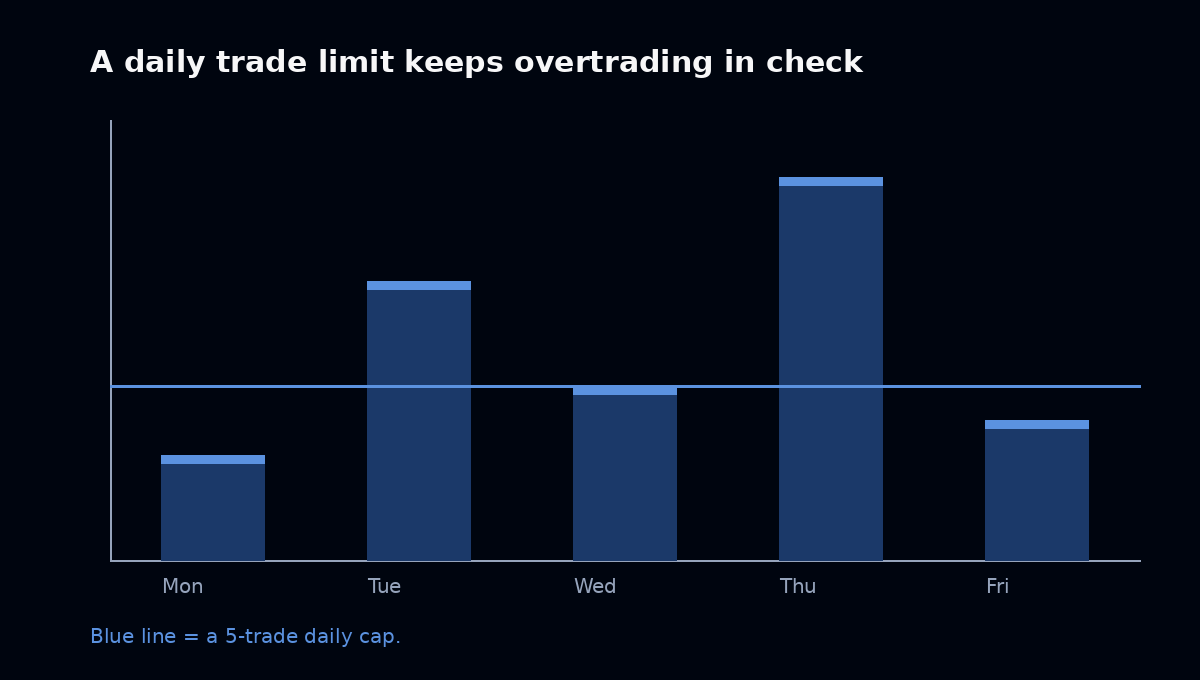
A maximum number of trades can be useful, but there is no universal daily limit. Review previous sessions: how many valid opportunities does your strategy normally produce? Do later trades tend to have weaker setups or higher costs? Are rule violations more common after a certain number of positions? If historical data is limited, establish a provisional rule and review it over subsequent sessions.
Rule 3: Establish a Daily Stopping Point
A personal daily stop creates a defined point at which no additional positions should be opened - for example, after two consecutive losses or after reaching a predetermined monetary loss. For prop traders, this personal stopping point is separate from the firm's official daily loss limit and should remain within the programme's permitted boundaries, with room for open exposure and execution differences.
Rule 4: Introduce a Pause Between Trades
Overtrading becomes easier when opening another position requires almost no thought. A short pause can create enough time to review whether the next trade is justified. Before entering, ask: Would I take this position if my previous trade had never happened? The pause should also provide time to confirm the setup, stop-loss, position size, and remaining account exposure.
Rule 5: Stop Trying to Recover Losses on a Schedule
The market does not know that you lost $300 earlier in the day, and it does not owe you another opportunity before the session ends. A valid setup may appear after a losing trade, but the need to recover money is not itself a valid setup. Each new position should be evaluated independently against the original criteria.
Rule 6: Record Trades You Wanted to Take but Skipped
When a potential position does not meet your rules, record the idea without executing it: note the proposed entry, invalidation level, and reason it was rejected. Later, review what happened. A missed profitable trade does not automatically mean the rule was wrong; evaluate a meaningful sample before changing the strategy.
Rule 7: Review Rule Adherence, Not Just Profit
At the end of each session, examine whether every position followed the trading plan. A profitable impulsive trade should still be recorded as a rule violation, and a losing trade that followed the strategy may have been a valid decision. This prevents short-term outcomes from reinforcing poor habits.
Three Planned Trades vs Eight Actual Trades
Consider a hypothetical trader with a $25,000 account. The trading plan permits up to three qualifying setups during the session, with $100 of planned risk per trade. The first three positions produce:
| Trade | Result |
|---|---|
| Trade 1 | +$200 |
| Trade 2 | -$100 |
| Trade 3 | +$150 |
| Planned session result | +$250 |
At this point, the session is profitable. However, the trader continues opening positions despite having no additional qualifying setups. Five unplanned trades follow, producing a combined loss of $400. The final session result becomes +$250 - $400 = -$150.
The problem was not that the trader exceeded a particular number of trades. It was that the additional positions did not meet the strategy's requirements. In this hypothetical example, unplanned activity turned a profitable session into a losing one.
Why Overtrading Is Dangerous in Prop Firm Challenges
Prop firm evaluations may include daily loss limits, maximum drawdown thresholds, and other account restrictions. Repeated entries can increase transaction costs and cumulative exposure, even when individual positions appear relatively small.
Imagine a trader approaching the remaining daily loss allowance. One additional impulsive position could contribute to a breach, particularly if the market moves sharply or execution differs from the intended stop-loss price. This is why a personal trading plan should account for the programme's official restrictions before any positions are opened. Overtrading is not necessarily defined by the number of trades a prop firm permits; it is the failure to keep activity within the trader's strategy and applicable account conditions.
Prepare Your Strategy Before Starting a Challenge
River Valley Capital offers One-Step and Two-Step evaluation options. Before choosing a programme, review its current rules and determine how your strategy will manage trade frequency, position sizing, and daily exposure.
A Five-Day Plan to Reduce Overtrading
If unnecessary trading has become a recurring problem, focus on one behaviour at a time.
- Day 1 - Review Your Recent Trades: Identify positions that did not meet your written setup criteria. Look for repeated patterns rather than isolated mistakes.
- Day 2 - Identify the Trigger: Determine whether unnecessary entries tend to follow losses, missed market movements, winning streaks, or periods of inactivity.
- Day 3 - Create One Prevention Rule: Make the rule specific and observable, for example requiring a documented setup before every new position.
- Day 4 - Test the Rule: Apply it in simulation or another suitable controlled environment. Record when it prevents an entry and whether any exceptions occur.
- Day 5 - Review the Results: Determine whether the rule was followed and whether it needs clarification.
Five days cannot establish that a strategy has improved. The exercise provides a starting point for developing a more consistent decision-making process. Continue monitoring the results over a longer period before drawing conclusions.
When Taking Fewer Trades Is Not the Answer
Reducing trade count does not automatically improve performance. If a strategy legitimately generates numerous independent, qualified opportunities, imposing an arbitrary limit may exclude valid trades. The better objective is to reduce unplanned decisions rather than trading activity itself.
That requires clear entry criteria, accurate records, and enough evidence to distinguish normal trading frequency from behaviour that undermines the strategy. The most useful question is not *"How many trades should I take?"* It is: "Which trades would I still take if I had no emotional attachment to today's result?" For a broader explanation of the emotions that influence trading behaviour, read our Trading Psychology Guide.
Build a Trading Process That Prevents Unnecessary Entries
Overtrading becomes easier to control when every position must meet a clear standard. The objective is not to avoid market participation; it is to ensure that each decision belongs to a strategy that can be explained, measured, and followed consistently.
A predefined trading plan, personal stopping rules, and regular performance reviews can help reduce unnecessary exposure. For traders preparing for a prop firm evaluation, these habits should be developed before purchasing an account. Review the available programme structures and compare River Valley Capital trading accounts to confirm that your strategy is compatible with the applicable conditions.