By The River Valley Capital Team ·

What Is Trading Psychology?
Trading psychology refers to the emotions, beliefs, cognitive biases, and behavioural patterns that influence how traders make decisions. It affects how traders respond to losses, manage profitable positions, handle uncertainty, and evaluate their own performance.
Two traders can identify the same market opportunity and behave very differently. One follows a predefined entry, position size, and exit strategy. The other hesitates, enters late, increases exposure after a loss, or closes a profitable position prematurely. Their market analysis may be identical. Their decisions are not.
Understanding trading psychology does not mean eliminating emotions. Fear, excitement, frustration, and uncertainty are normal when financial outcomes are involved. The objective is to recognise when those emotions begin overriding the trading plan.
The Trading Session That Went Wrong
Consider a hypothetical trader in a prop firm evaluation. The account begins the day at $50,000. The trader's personal plan allows $150 of risk per trade and requires trading to stop after two consecutive losses.
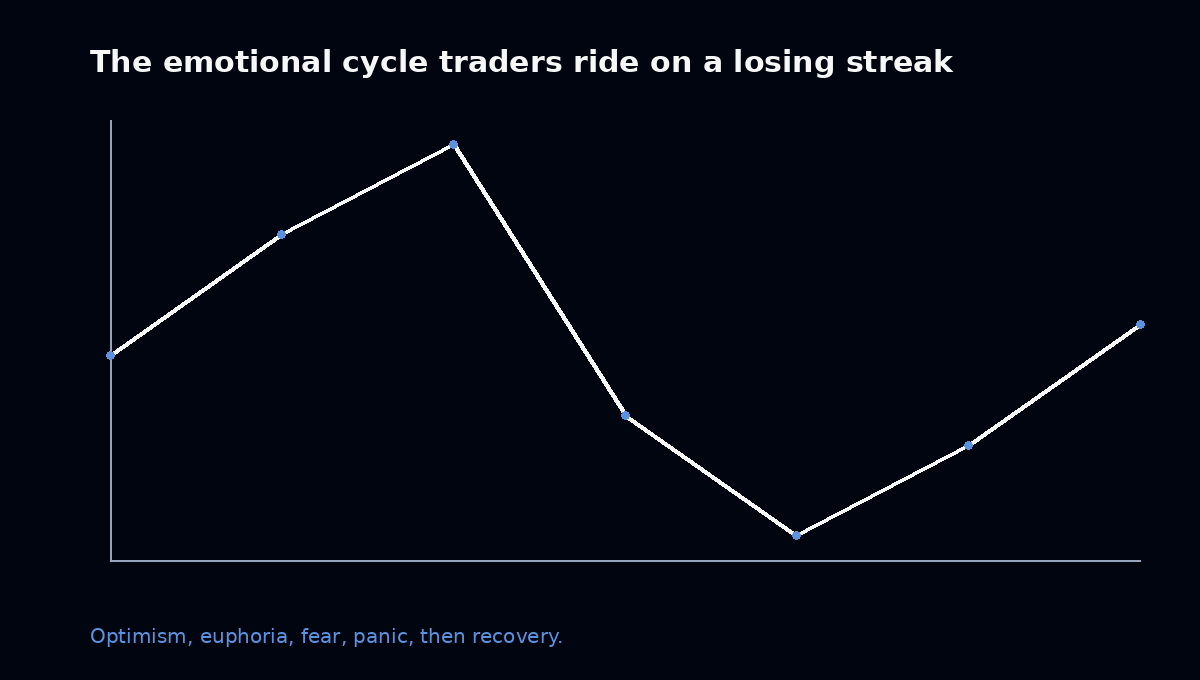
At 9:15 AM, the first position reaches its stop-loss. Result: -$150. The trade followed the plan. At 9:40 AM, another valid setup appears. It also loses. Result: -$150. The trader is now down $300, and according to the plan the session should end.
Instead, the trader thinks: *"I only need one good trade to recover this."* At 10:05 AM, a third position opens with $300 of planned risk that does not meet the normal strategy conditions. It loses. The total reaches $600. A fourth position follows with $400 of planned risk. It also loses. Final session result: -$1,000.
The first two trades produced an ordinary $300 loss. The next two added $700 because the trader abandoned the process. A losing trade is a trading outcome. Breaking your rules because of that loss is a behavioural decision. *This example is hypothetical and does not describe River Valley Capital's official trading conditions.*
Five Emotional Patterns That Influence Trading
1. Fear: When Avoiding Losses Becomes the Priority
Fear does not always make traders reckless. Sometimes it makes them excessively cautious. A trader may identify a valid setup but refuse to enter because the previous trade lost. Another may close a profitable position early, afraid the unrealised gain will disappear. Fear can also encourage moving stop-loss orders to avoid accepting a realised loss. Before entering, ask: Would I take this trade if my previous position had been profitable? If the answer changes because of the previous outcome, fear may be influencing the decision.
2. Greed: When a Good Result No Longer Feels Sufficient
A profitable trade can create its own pressure. As the market approaches a target, the trader begins thinking about how much more could be made by holding longer. Allowing profits to run is not inherently a mistake; it can be part of a legitimate strategy. The problem begins when the trader changes the original exit plan without a strategy-based reason.
3. Revenge Trading: Trying to Recover Losses Immediately
Revenge trading occurs when recovering a previous loss becomes more important than identifying a valid opportunity. Common warning signs include:
- Increasing position size after losing.
- Entering trades without a valid setup.
- Opening another position immediately after a loss.
- Ignoring personal stopping rules.
A practical response is a predefined interruption rule, for example: *"After two consecutive losses, I stop opening new positions for the session."* The purpose is to make the decision before frustration appears.
4. FOMO: Entering Because the Market Is Moving
Fear of missing out can make traders feel that every strong price movement represents a missed opportunity. The original entry has already passed, but the trader enters anyway. The position now has a different entry price, risk profile, and potential reward from the planned setup. The important question is whether the trade still meets the original entry conditions. Missing a trade does not create an obligation to take the next one.
5. Overconfidence: When Winning Creates Poor Decisions
A series of profitable trades can make traders believe they understand the market better than their record supports. They may increase position sizes, ignore weaker signals, or stop documenting decisions. Confidence should come from a repeatable process and an adequate trading record, not a short winning streak.
Why Trading Psychology Matters in Prop Firm Challenges
Prop firm evaluations can introduce additional psychological pressure. Traders may need to reach a profit objective while respecting daily loss limits, maximum drawdown restrictions, and other programme conditions. These requirements can change how a trader interprets an otherwise ordinary loss.
For example, a trader approaching a profit target may become impatient and increase position size to complete the evaluation sooner. Another trader near a drawdown threshold may hesitate on valid setups or take unnecessary risks in an attempt to recover. Neither reaction necessarily improves the underlying strategy.
The challenge is to treat evaluation rules as boundaries within which the trading plan must operate. River Valley Capital offers different evaluation structures, allowing traders to compare the conditions before choosing an account.
How to Control Emotions While Trading
Emotional discipline becomes more practical when it is built into the trading process. Instead of relying on motivation or confidence, traders can establish rules that reduce the number of decisions made under pressure.
Make Important Decisions Before Entering
A trading plan should define the entry conditions, invalidation point, intended exit, and acceptable exposure. A trader who already knows what will happen if the position reaches the stop-loss has one fewer decision to make during a stressful moment.
Create a Pause Between Trades
Not every closed position needs to be followed by another. After a frustrating trade, stepping away from the screen can interrupt the urge to recover losses immediately. The pause should be part of the predefined routine rather than something introduced only after a serious mistake.
Reduce Exposure When Execution Becomes Inconsistent
Reducing planned exposure can make it easier to evaluate whether the strategy is being executed correctly. This does not guarantee better results; it simply reduces the amount at stake while the trader works on consistency. For the mechanics of position sizing and exposure limits, read our Trading Risk Management Guide.
Stop Measuring Every Session Against a Profit Target
A daily profit target can become counterproductive if it encourages traders to force entries. A process-based objective may be more useful: *"Today, I will only take trades that meet my strategy conditions and remain within my risk limits."*
The Three-Minute Check Before Your Next Trade
Before opening a position, take a moment to answer five questions.
- Does this setup meet my strategy conditions? This identifies whether the trade is planned or impulsive.
- Would I take this position if my previous trade had won? This reveals whether a recent loss is influencing the decision.
- Is my position size within the original plan? This checks whether emotion has changed the intended risk.
- Am I trying to recover money quickly? This can reveal revenge trading.
- Can I accept the planned loss? This helps determine whether the exposure is psychologically manageable.
If the answers reveal a clear rule violation, the trade should not proceed under the original plan. This exercise does not predict market direction. It helps identify decisions that may be driven by emotion rather than strategy.
Your Trading Journal Should Record More Than Profit
Most traders record entry prices, exit prices, and financial results. A trading psychology journal should also capture what happened before and during the decision. For each trade, record:
- Emotional state: Calm, frustrated, anxious, excited, or impatient.
- Reason for entry: Planned setup or unplanned decision.
- Rule adherence: Whether the original strategy was followed.
- Response to the result: Whether the outcome influenced the next trade.
After several weeks, review the records for recurring patterns. Perhaps oversized positions tend to follow winning streaks, or missed opportunities become more common after losses. These observations are more actionable than simply deciding to become a more disciplined trader. They identify the circumstances in which discipline breaks down.
A Good Trade Can Lose. A Bad Trade Can Win.
Suppose a trader follows the strategy perfectly, uses the planned position size, and exits at the predefined stop-loss. The trade loses $100. Now imagine another trader enters without a valid setup, ignores the original risk limit, and earns $300. Which decision was better?
Based on process quality, the first trader made the more disciplined decision. The second received a favourable outcome from a decision that may be difficult to repeat consistently. Profitable results do not automatically validate poor execution, and losses do not automatically indicate a flawed decision. Traders who judge every decision only by its immediate financial outcome may reinforce habits that become damaging over time.
What to Do After a Difficult Trading Day
The most useful response to a difficult session is not necessarily more market analysis. First, determine whether the losses came from valid trades or rule violations. If the trades followed the plan, review them as part of the strategy's normal performance. If the trader increased risk, chased entries, or ignored predefined limits, identify the specific decision that caused the deviation.
Then establish a practical response for the next session, for example: *"If I feel an urge to increase my position size after a loss, I will stop trading and review the setup before taking another position."* A specific response is easier to evaluate than a general promise to remain calm. Trading psychology improves through repeated observation and better decisions, not through the expectation that emotions will disappear.
Build Discipline Before Starting a Trading Challenge
Successful trading decisions are not defined only by whether a position makes money. They are also defined by whether the trader follows a process that can be measured, reviewed, and repeated. Fear, greed, frustration, and overconfidence will not disappear completely; what can change is how traders respond when those emotions appear.
For anyone considering a prop firm evaluation, that process should begin before purchasing an account. Review the programme's objectives, understand the trading restrictions, and compare River Valley Capital trading accounts to choose a structure that fits your strategy and personal risk plan.