By The River Valley Capital Team ·

What Is Trailing Drawdown?
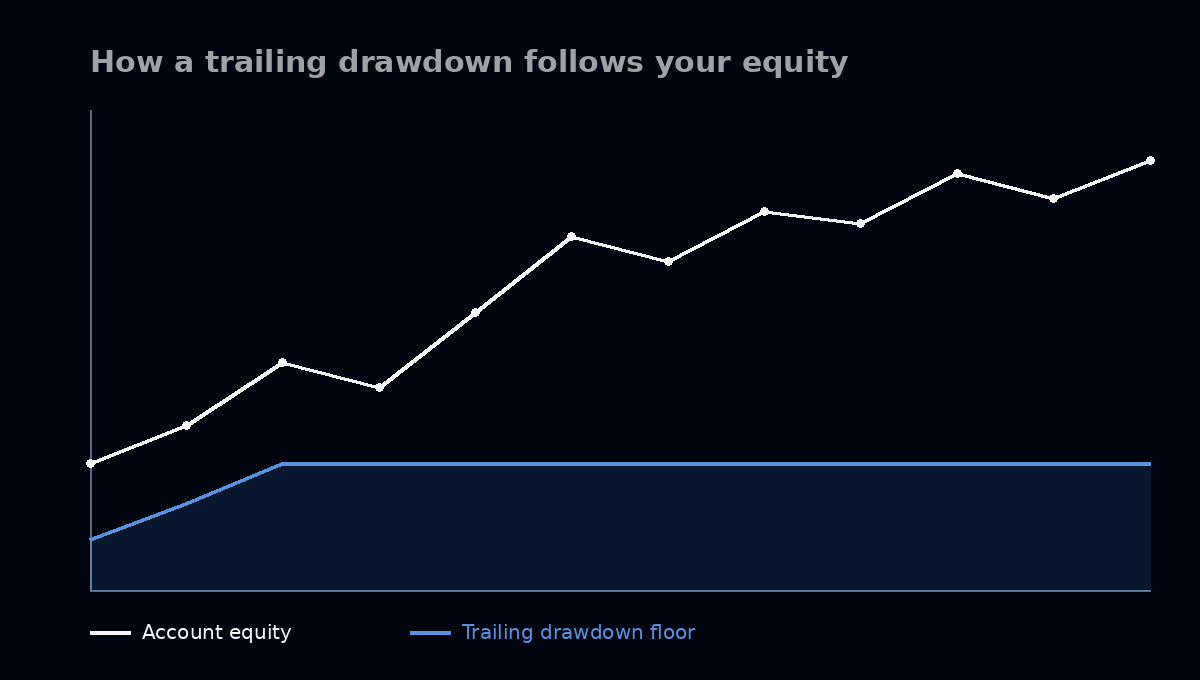
Trailing drawdown is a maximum-loss limit that follows your account's highest value as it grows. The level it sits at is called the drawdown floor: if your balance touches it, the account is breached.
Unlike a static limit, which never moves, a trailing floor ratchets upward every time you set a new high. It does not move back down when you lose, so the gap between your balance and the floor can shrink even while you are in profit.
How Trailing Drawdown Works, Step by Step
- You start with an allowance. On a $100,000 account with an 8% trailing drawdown, the floor begins at $92,000.
- A new high raises the floor. Reach $103,000 and the floor rises by the same $3,000 to $95,000.
- A loss never lowers the floor. Drop back to $101,000 and the floor stays at $95,000. You now have $6,000 of room instead of the $8,000 you started with.
- Touching the floor breaches the account. Whether the test uses your balance or your equity depends on the programme's rules.
Why the Order of Your Trades Matters
Because the floor follows your highest closed balance and never moves back down, the order in which you win and lose can change how much drawdown room you keep, even when you end the day at the same balance. Here are two scenarios on a $100,000 Instant account, where the floor starts at $92,000.
Scenario A: win first, then lose
You close a $2,500 winner, so your balance rises to $102,500. That is a new closed-balance high, so the floor rises to $94,500. You then close a $1,000 loser, bringing your balance to $101,500. The floor stays at $94,500, because it only ever moves up. That leaves $7,000 of room.
Scenario B: lose first, then win
You close a $1,000 loser first, so your balance falls to $99,000. That is not a new high, so the floor stays at $92,000. You then close a $2,500 winner, bringing your balance to $101,500. Now it is a new high, so the floor rises to $93,500. That leaves $8,000 of room.
| Scenario A (win first) | Scenario B (lose first) | |
|---|---|---|
| Highest closed balance | $102,500 | $101,500 |
| Final balance | $101,500 | $101,500 |
| Drawdown floor | $94,500 | $93,500 |
| Room remaining | $7,000 | $8,000 |
Both days net the same $1,500 and end at the same $101,500 balance, yet Scenario B leaves $1,000 more room. The reason is the high-water mark: winning big and then giving some back sets a higher peak, which locks your floor higher for good. It is not a reason to trade scared, but it is worth knowing that every new closed-balance high permanently raises the floor you must stay above.
The Trailing Drawdown Formula
For a trailing model without a lock, the floor is simply:
Floor = Highest account value − drawdown allowance
On an 8% account the allowance is 8% of the starting balance. So on $100,000 the allowance is $8,000, and the floor is always $8,000 below your highest recorded value until it locks (see below).
Trailing vs Static Drawdown
A static floor is fixed at the start and never moves. A trailing floor chases your highest value, then stops.
| Feature | Static drawdown | Trailing drawdown |
|---|---|---|
| Starting floor | Fixed amount below start | Fixed amount below start |
| After a new high | Unchanged | Rises with the account |
| After a loss | Unchanged | Stays at its highest point |
| Main risk | Large early loss | Giving back profit |
Why a Profitable Account Can Still Breach
This is the trap. Say you push a $100,000 account to $107,000, so the floor has trailed up to $99,000. If you then give back $8,500 and sit at $98,500, you are still $1,500 above where you started, yet the account is breached because your balance fell through the $99,000 floor.
Profit on the screen is not the same as headroom. Always measure the distance between your balance and your floor, not between your balance and your starting balance.
How River Valley Capital Uses Trailing Drawdown
At River Valley Capital, only Instant Funding uses a trailing maximum drawdown, set at 8%. The 1-Step and 2-Step challenges use a static floor instead.
The Instant Funding floor trails your highest closed balance by 8%, then locks for good once you reach your starting balance plus 8%. On a $100,000 account that means the floor rises until it reaches $100,000, and from then on it never moves again. You can model any account size with our prop firm calculator.
How to Protect Your Drawdown Headroom
- Track the gap to your floor after every session, not your profit.
- Bank a buffer: keep at least one full daily loss limit between your balance and the floor.
- Size down near a new high, when the floor is still moving and your room is smallest.
- Remember the daily loss limit as well as the overall floor; breaching either ends the account.