By The River Valley Capital Team ·

What Is a Prop Firm?
A proprietary trading firm, commonly called a *prop firm*, is a business associated with trading financial markets using capital or trading arrangements provided by the firm. Traditionally, proprietary trading firms employed professional traders to trade the firm's own capital.
The modern online prop trading industry often operates differently. Many providers offer paid evaluation programmes that allow individuals to demonstrate their trading ability under predefined conditions. Successful participants may then become eligible for a funded-account arrangement, subject to the provider's terms. In some cases, the trading environment remains simulated, and eligible payouts are based on contractual performance arrangements rather than direct participation in live market profits.
This distinction matters because the term *funded account* does not necessarily mean a trader receives unrestricted access to real capital. The account's advertised size, trading environment, payout structure, and legal relationship should be evaluated separately.
How Do Prop Firms Work? The Five Main Stages
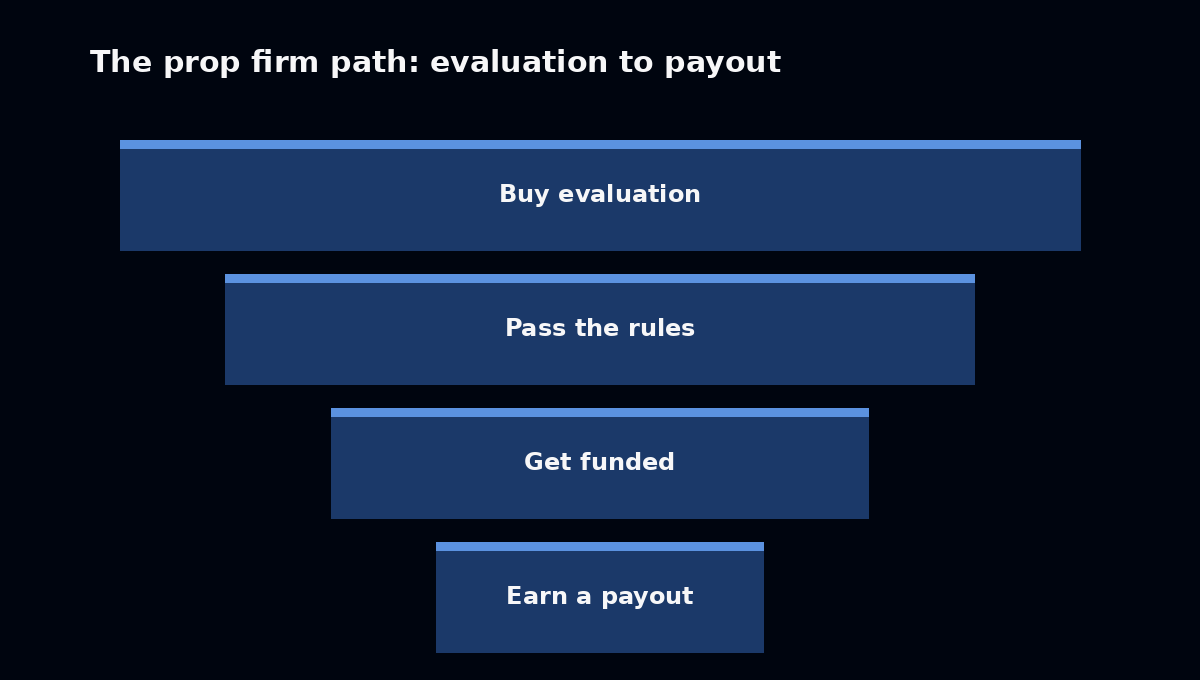
Although providers use different models, many online prop trading programmes follow a similar sequence.
Stage 1: Choose a Trading Programme
The trader begins by selecting an account structure. Programmes may differ in their evaluation requirements, advertised account sizes, trading restrictions, and fees. A trader might choose a one-step evaluation, a two-step evaluation, or another available arrangement. Before purchasing, the trader should understand what the fee covers and whether it is refundable.
Stage 2: Complete the Evaluation
Many online prop firms use trading challenges to assess whether participants can meet defined objectives while remaining within specified risk limits. For example, a hypothetical $50,000 evaluation might require a trader to achieve $4,000 in qualifying profit without breaching a $3,000 maximum-loss threshold. These figures are illustrative, not River Valley Capital's official conditions. The evaluation may also include daily loss restrictions, minimum trading days, consistency requirements, or other rules.
Stage 3: Meet Any Additional Requirements
Some programmes require participants to complete more than one evaluation stage. A two-step structure may involve an initial assessment followed by a second phase with its own requirements. The number of stages does not, by itself, establish which option is easier or more suitable. A trader should compare the actual objectives, loss calculations, fees, and conditions rather than relying only on the programme name.
Stage 4: Enter the Funded-Account Arrangement
After satisfying the evaluation requirements, a trader may become eligible for the provider's funded-account arrangement. This does not automatically mean that the advertised account balance becomes the trader's personal property. The account may operate in a simulated environment, a live environment, or another arrangement described in the provider's contract. The most important question is what the trader is contractually entitled to receive and under which conditions.
Stage 5: Trade Within the Ongoing Rules
Passing an evaluation does not necessarily remove account restrictions. Depending on the provider, participants may still need to respect maximum drawdown limits, daily loss limits, prohibited trading practices, or payout eligibility conditions. Understanding the full lifecycle of the programme is therefore more useful than focusing exclusively on passing the initial challenge.
Where Does the Money Come From?
The financial structure of an online prop firm depends on its business model. Some providers generate revenue from evaluation fees, account-related charges, or other services. Others may have arrangements involving live trading activity or additional commercial revenue streams.
It is important not to assume that every online prop firm operates like a traditional proprietary trading desk. Similarly, a participant's payout may be determined by contractual performance rules rather than a direct ownership share of live market trading profits. Before joining, review how the provider describes its trading environment and payout obligations. A transparent explanation of these details helps distinguish the advertised opportunity from the actual contractual arrangement.
How Do Prop Firm Profit Splits Work?
A profit split determines how eligible trading performance is allocated between the participant and the provider. For example, imagine a hypothetical programme offering an 80% participant share. If a trader generates $2,000 in eligible performance-based profit and all payout conditions are satisfied, the participant's calculated share would be:
$2,000 x 80% = $1,600
The remaining $400 would represent the provider's share under this simplified example. However, the actual amount payable can depend on additional contractual conditions, which may include payout thresholds, eligibility requirements, fees, adjustments, or restrictions on particular trading activities. A quoted profit split should never be considered independently of the complete payout policy. River Valley Capital applies an 80% standard profit split, rising to 90% with the available add-on.
Why Prop Firms Have Trading Rules
Prop firms use trading rules to define acceptable account activity and limit exposure under their programme structures. Common categories include maximum-loss restrictions, daily loss limits, trading conduct requirements, and conditions governing payouts.
These rules can materially affect how a strategy performs within an evaluation. For example, a trader may have a strategy that produces positive returns over several months but experiences substantial temporary account declines. That strategy could be incompatible with a programme that has a relatively restrictive maximum-loss threshold, while a different trader using smaller positions and experiencing lower drawdown may find the same programme easier to operate within.
The point is not that one strategy is universally better. It is that the account conditions must be compatible with the strategy's actual risk characteristics. For a detailed explanation of account declines and loss thresholds, read our Guide to Drawdown in Trading.
One-Step vs Two-Step Prop Firm Challenges
One-step and two-step challenges describe different evaluation structures. A one-step challenge generally involves one evaluation stage before the participant can qualify for the next arrangement. A two-step challenge generally requires two evaluation stages.
However, the number of stages does not tell the full story. Profit objectives, maximum-loss calculations, fees, trading conditions, and payout eligibility may differ between programmes. A one-step structure is not automatically more favourable simply because it has fewer stages, and a two-step structure is not automatically more restrictive. The appropriate comparison is based on the published programme conditions.
Compare River Valley Capital's Challenge Options
River Valley Capital provides dedicated pages for traders evaluating different challenge structures. Review the current terms before selecting an account.
Are Prop Firms Available to Traders in the UK?
Traders researching prop firms in the United Kingdom should examine more than account size and advertised payouts. Relevant considerations include the provider's contractual structure, eligibility requirements, applicable restrictions, and the nature of the trading arrangement.
A firm's website availability does not automatically establish that every programme is suitable or legally available to every UK resident. Regulatory treatment can depend on the services offered and the specific business model. Traders should review the provider's current terms and seek qualified advice where necessary. For location-specific information, explore River Valley Capital's dedicated Prop Firm UK page.
How Do Prop Firms Work for Traders in Singapore?
The general evaluation process may be similar for traders in different countries, but participation requirements and legal considerations can vary. Singapore-based traders should confirm whether they are eligible for a particular programme, which contractual entity provides it, and what rules govern account activity and payouts.
They should also consider any relevant local legal or tax obligations. Access to an online trading platform should not be interpreted as confirmation of regulatory approval or unrestricted eligibility. River Valley Capital provides additional location-specific information on its Prop Firm Singapore page.
What Should You Check Before Joining a Prop Firm?
A useful evaluation begins with questions about how the programme actually operates.
- Is the account simulated or live? Understand the trading environment and what the advertised account balance represents.
- What are the maximum-loss restrictions? Check whether limits are static or trailing and whether unrealised losses count.
- What happens after passing the evaluation? Review onboarding requirements, account conditions, and the nature of the subsequent arrangement.
- How are payouts calculated? Examine the profit split, eligibility conditions, payment schedule, and any applicable restrictions.
- What happens if a rule is breached? Understand the consequences of violating daily limits, maximum drawdown rules, or trading conduct requirements.
- What fees and contractual conditions apply? Review evaluation fees, refund provisions, account termination rules, and any other material terms.
These questions are useful regardless of the account size or programme structure. They help traders compare actual conditions instead of relying exclusively on marketing claims.
Are Prop Firms Suitable for Beginners?
Prop firm programmes may appeal to traders who want to participate in a structured evaluation without committing the advertised account balance as personal trading capital. However, that does not make them risk-free: participants may lose evaluation fees, fail to qualify, or breach programme conditions.
Beginners who have not yet developed a repeatable trading strategy may also find it difficult to manage both market risk and evaluation restrictions. Before purchasing a challenge, it is useful to understand position sizing, stop-loss execution, trading costs, and account drawdown. Practising in a suitable simulated environment can help traders become familiar with their strategy and execution process before paying for an evaluation. No amount of preparation guarantees that a trader will pass a challenge or become eligible for payouts.
Understand the Programme Before Choosing an Account
The central question behind *how do prop firms work* is not simply how traders access an advertised account balance. It is how the evaluation, account rules, trading environment, and payout arrangement fit together.
Modern online prop firms can operate under different business models, and their programmes should not be assumed to provide identical rights or conditions. A trader who understands these distinctions is better positioned to compare available options and determine whether a particular structure is compatible with their strategy. Before joining, review the complete terms, verify the current trading restrictions, and explore River Valley Capital trading accounts to understand how eligibility and payouts are determined.