By The River Valley Capital Team ·

Which Prop Firms Have No Minimum Trading Days?
| Prop firm | Programme | Evaluation minimum | Worth knowing |
|---|---|---|---|
| River Valley Capital | 1-Step | None | No consistency rule |
| River Valley Capital | 2-Step | None in either phase | No consistency rule |
| River Valley Capital | Instant Funding | No evaluation | No minimum at any stage |
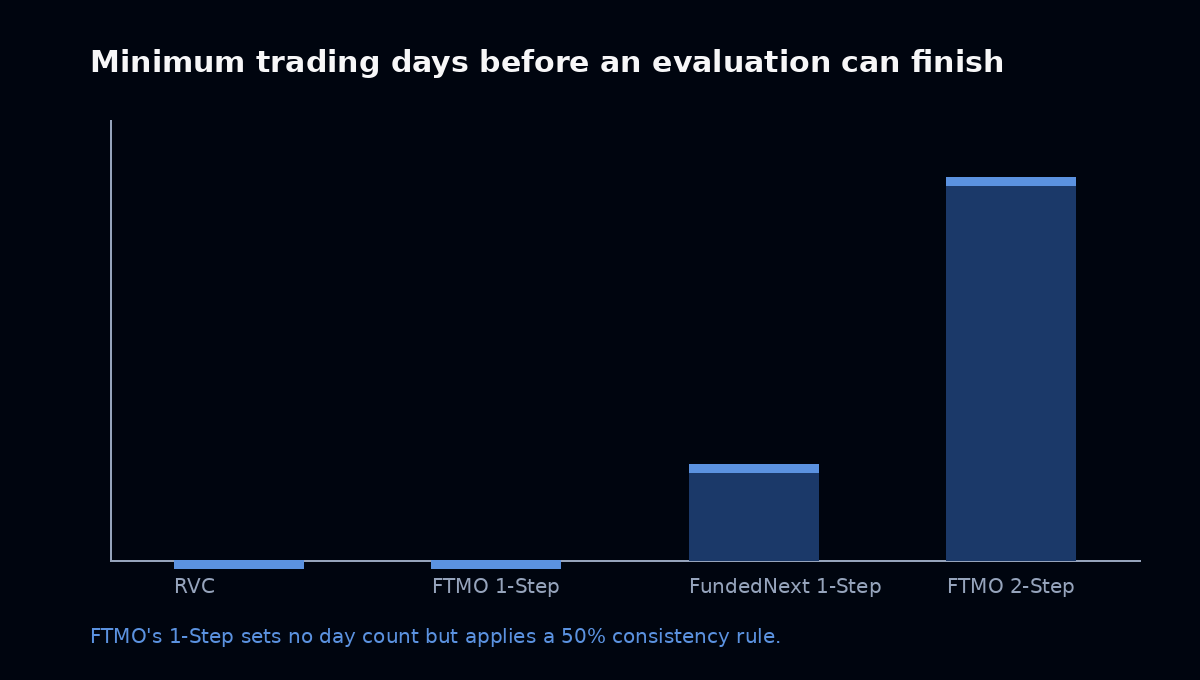
| FTMO | 1-Step | Not published as an objective | 50% consistency rule applies |
| FTMO | 2-Step | 4 days per phase | None on the funded account |
| FundedNext | Stellar 1-Step | 2 days | 6% static maximum loss |
| FundedNext | Stellar 2-Step | 5 days per phase | None on the funded account |
| FundedNext | Stellar Instant | No evaluation | No minimum at any stage |
| FXIFY | 2-Phase Pro | 3 profitable days per phase | Each day must close 0.5% up |
Competitor figures were read on 19 November 2026 from each firm's own published rules: FTMO's trading objectives, FundedNext's trading objectives and its minimum trading days article, and FXIFY's 2-Phase Pro programme rules. Requirements can differ by purchase date, account type and reset, so check the current terms before buying.
The table makes one point clearly: no minimum trading days is a property of a specific programme, not of a firm.
River Valley Capital is unusual in applying it across all three of its programmes. Elsewhere it depends which product you buy. FundedNext asks for two days on Stellar 1-Step and five per phase on Stellar 2-Step. FTMO publishes no minimum-day objective on its 1-Step but four days per phase on its 2-Step.
FXIFY's 2-Phase Pro is the one to read twice. Its three days are three separately profitable days, each needing to close at least 0.5% up, which is a stiffer condition than a plain trading-day count.
What No Minimum Trading Days Actually Means
A minimum trading-day rule sets how many separate days you must place qualifying trades before an evaluation can complete. Hit your target on day one of a four-day programme and you keep trading anyway.
Removing that rule removes that one condition. Every other rule stays exactly where it was.
Three Conditions People Confuse
These sound similar and do different jobs:
- No minimum trading days. No required number of days before you can finish.
- No maximum trading days. No deadline to finish by.
- No consistency rule. No cap on how much of your total profit may come from your best day.
A programme can have no deadline and still demand five trading days. It can drop the minimum-day objective and still hold you back through a consistency percentage, which is what FTMO's 1-Step does with its 50% best-day rule.
The cleanest way to read any evaluation is to ask what sets the earliest possible finish, rather than looking for the words "no minimum trading days".
Can You Pass a Challenge in One Day?
Sometimes, if the programme has no minimum-day requirement and nothing else gets in the way. It is never guaranteed. The profit target, the daily loss limit, the maximum drawdown and the prohibited-trading rules all still apply, and a target large enough to need serious risk is its own constraint.
At River Valley Capital the 1-Step and 2-Step evaluations have no minimum trading-day requirement. The targets and risk limits are set out in the trading rules.
River Valley Capital: No Minimum on All Three Programmes
River Valley Capital applies no minimum trading-day requirement to any of its programmes, and no numerical consistency rule either.
| 1-Step | 2-Step | Instant Funding | |
|---|---|---|---|
| Minimum trading days | None | None in either phase | None |
| Profit target | 10% | 8% then 5% | None |
| Daily loss limit | 5% | 5% | 5% |
| Maximum drawdown | 6% static | 8% static | 8% trailing |
| Evaluation deadline | None | None | No evaluation |
| Consistency rule | None | None | None |
1-Step Challenge
One phase, a 10% profit target, a 5% daily loss limit and a 6% static maximum drawdown. Reach the target inside the risk limits and the phase is done, with no requirement to keep trading afterwards. Explore the 1-Step Challenge
2-Step Challenge
Two phases with 8% and 5% targets, a 5% daily loss limit and an 8% static maximum drawdown. Neither phase carries a minimum-day requirement, so the only thing standing between you and Phase 2 is the Phase 1 target. Explore the 2-Step Challenge
Instant Funding
No evaluation phase at all, so the question of evaluation days does not arise. The 5% daily loss limit, the 8% trailing drawdown on closed balance and the payout conditions all still apply. Explore Instant Funding
What About Trading Days Before a Payout?
River Valley Capital sets no separate minimum trading-day requirement on funded accounts. The first payout can be requested once the eligibility conditions are met, and subsequent requests follow a 30-day interval. Instant Funding has a minimum withdrawal of the greater of $100 or 1% of the starting balance.
Those are payout conditions rather than trading-day rules. One rule does bite on an untouched account: 30 consecutive days without trading breaches the inactivity rule. Full detail is in the payout policy.
How FTMO, FundedNext and FXIFY Compare
FTMO: It Depends Entirely on the Programme
FTMO's 2-Step Challenge requires at least four trading days in the Challenge phase and four in Verification, which is eight days minimum across the evaluation. FTMO defines a trading day as any day on which at least one position is opened, and publishes no minimum-day rule on the funded account that follows (FTMO trading objectives, read 19 November 2026).
FTMO's 1-Step does not publish a minimum trading-day objective. It does carry a 50% consistency rule, requiring that your best day is not more than half of your total profit, which means a single enormous day cannot carry the evaluation on its own.
FTMO Instant has no evaluation phase and publishes a 30% consistency rule on rewards.
The practical upshot: there is no single FTMO answer, and the commonly repeated "four day rule" applies to the 2-Step only.
FundedNext: Two Days, Five Days, or None
FundedNext publishes different minimums across the Stellar range.
| Programme | Minimum trading days |
|---|---|
| Stellar 1-Step | 2 |
| Stellar 2-Step | 5 per phase |
| Stellar Lite | 2 per phase on accounts bought or reset on or after 12 October 2026, 5 per phase before that date |
| Stellar Instant | None, and no evaluation |
FundedNext states that there is no minimum trading-day requirement on the funded accounts that follow its Stellar Lite, 1-Step and 2-Step challenges, and a 60-day inactivity rule applies across its CFD accounts (FundedNext minimum trading days, read 19 November 2026).
The Stellar Lite split by purchase date is worth noting generally: minimum-day rules are often changed for new accounts only, so a review written last year may not describe the account you are about to buy.
FXIFY: Profitable Days, Not Trading Days
FXIFY's 2-Phase Pro asks for three minimum trading days per phase, but defines them narrowly. A day only counts if the account closes it at least 0.5% up on the phase's starting balance, measured on both balance and equity at the 5:00 PM cut-off. FXIFY also applies a $4,000 daily profit cap on Pro, above which the account turns read-only for the rest of the day.
Its other 2-Phase variants publish their own minimums, with Classic listed at four days per phase and Standard at five (FXIFY 2-Phase Pro rules, read 19 November 2026). These are variant-specific: FXIFY's programmes do not share one rule set.
Three profitable days is a materially harder requirement than three trading days, and it is the clearest example of why the minimum-day number alone is not enough to compare programmes.
Trading Days, Profitable Days and Payout Timing
Four separate conditions get flattened into "minimum trading days" in most comparisons. They are not the same thing.
Evaluation trading days count how many days you place qualifying trades before progressing. Firms differ on what qualifies: FTMO counts any day a position is opened, while FundedNext requires a trade with non-zero profit or loss.
Minimum profitable days require the day to end in profit, often above a threshold. FXIFY's 2-Phase Pro needs 0.5% on the day. This is much harder than placing a trade.
Consistency requirements cap how much of your total profit may come from your best day. They do not set a day count, but they can force you to keep trading, which has the same practical effect on your earliest finish. River Valley Capital applies no numerical consistency rule across its programmes. For how firms calculate these, see prop firms with no consistency rule.
Payout waiting periods govern when a reward can be requested, not whether you must trade. A programme can let you qualify in a day and still make you wait before the first withdrawal.
When comparing firms, check the evaluation minimum, the funded-account requirement and the payout timing separately. A programme can be generous on one and restrictive on another.
How to Choose Without Getting Caught Out
Check the Profit Target Alongside the Day Count
No minimum days does not mean easy. A 10% single-phase target asks for more in one run than 8% and 5% split across two phases. Removing the day requirement changes how quickly you can finish, not how much you must make.
Confirm the Risk Limits Separately
Daily loss limits and maximum drawdown apply regardless. Check how the daily limit is calculated and when it resets: River Valley Capital uses the greater of the previous day's closing balance or equity at the 5:00 PM New York reset.
Read the Trading Restrictions
News trading, overnight and weekend positions, automated strategies, copy trading and inactivity rules all shape what you can actually do. At River Valley Capital there is no minimum trading-day requirement, but 30 consecutive days without a trade breaches the inactivity rule.
Look at Payout Eligibility Before You Buy
Minimum withdrawal, payout frequency and any post-payout change to the drawdown floor matter more over the life of an account than the day count does during evaluation. At River Valley Capital the drawdown floor moves to the starting balance once a payout is approved, unless the Remove Lock on Payout add-on applies.
Compare the Whole Offer
Fees, account sizes, platforms, evaluation structure and profit split together decide whether a programme suits you. A single advertised feature rarely does. Current fees for every size are on the accounts page.