By The River Valley Capital Team ·

What Is a Consistency Rule in Prop Trading?
A consistency rule is a requirement that limits how much of a trader's total profit can come from one trading day or another defined period.
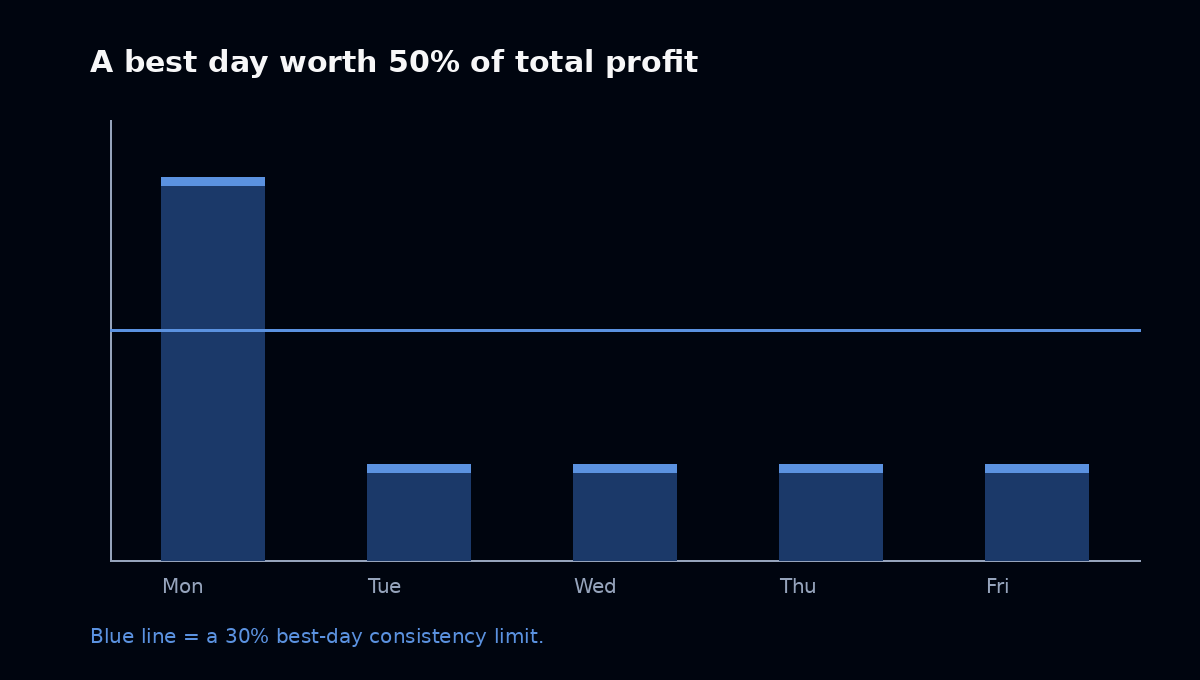
For example, a prop firm might require that your most profitable day represents no more than 30% of your total profits.
Suppose you are trading a $100,000 simulated account and make:
| Trading day | Profit |
|---|---|
| Monday | $4,000 |
| Tuesday | $1,000 |
| Wednesday | $1,000 |
| Thursday | $1,000 |
| Friday | $1,000 |
| Total | $8,000 |
Your best trading day generated $4,000, or 50% of your total profit.
If your programme has a 30% best-day consistency limit, you have not satisfied that condition.
Depending on the firm's rules, you may need to continue trading until the percentage falls below the permitted threshold.
Not every firm calculates consistency the same way. Some impose the condition during evaluation, while others apply it when traders request a payout.
Which Prop Firms Have No Consistency Rule?
Several prop trading programmes operate without a numerical profit-consistency requirement, although the conditions differ between firms and account types.
River Valley Capital states that it has no consistency rule across its three programmes.
| River Valley Capital programme | Consistency rule | Minimum trading days | Evaluation phases |
|---|---|---|---|
| 1-Step Challenge | None | None | One |
| 2-Step Challenge | None | None | Two |
| Instant Funding | None | None | No evaluation |
This means River Valley Capital does not require traders to generate profits in evenly distributed daily amounts to meet a consistency percentage.
However, it is important to distinguish between having no consistency rule and having no trading restrictions.
Traders must still comply with the firm's risk-management requirements, account conditions and prohibited trading practices.
Why Do Traders Prefer Prop Firms Without Consistency Rules?
Trading results are rarely identical every day.
Some strategies produce many small winning trades. Others generate fewer opportunities, with a significant portion of profits coming from particular market conditions.
A consistency rule can affect the way traders manage their evaluation or payout eligibility.
No Best-Day Profit Percentage to Meet
Without a numerical consistency requirement, traders do not need to reduce the proportion of total profits attributed to their best day.
At River Valley Capital, a profitable trading day does not create an additional percentage-based consistency target.
More Flexibility Around Trading Opportunities
Some trading strategies involve waiting for specific market conditions rather than entering trades every day.
A programme without a consistency requirement allows traders to focus on their strategy without needing to distribute profits evenly.
No Minimum Trading Days at River Valley Capital
River Valley Capital also has no minimum trading-day requirement across its programmes.
For its evaluation challenges, this means traders do not have to complete a specified number of trading sessions before satisfying the evaluation requirements.
All other programme rules still apply. You can view the full trading rules.
How River Valley Capital's Programmes Work Without One
River Valley Capital offers three different simulated trading programmes.
All three have no numerical consistency rule, but their profit targets and maximum drawdowns differ.
| Feature | 1-Step | 2-Step | Instant Funding |
|---|---|---|---|
| Consistency rule | None | None | None |
| Evaluation phases | One | Two | None |
| Profit target | 10% | 8% then 5% | No evaluation target |
| Daily loss limit | 5% | 5% | 5% |
| Maximum drawdown | 6% static | 8% static | 8% trailing |
| Minimum trading days | None | None | None |
| Weekend holding | Allowed | Allowed | Add-on required |
| Standard profit split | 80% | 80% | 80% |
Programme details are based on River Valley Capital's published rules as reviewed in November 2026.
River Valley Capital 1-Step Challenge
The 1-Step Challenge has one evaluation phase with a 10% profit target.
It includes a 5% daily loss limit and 6% static maximum drawdown.
There is no numerical consistency rule or minimum trading-day requirement.
This may appeal to traders who want a single evaluation phase and prefer a static maximum-loss floor.
River Valley Capital 2-Step Challenge
The 2-Step Challenge requires an 8% profit target in Phase 1 and 5% in Phase 2.
It has a 5% daily loss limit and 8% static maximum drawdown.
Like the 1-Step programme, it does not impose a consistency requirement or minimum trading days.
This option may suit traders who prefer dividing the evaluation into two phases with a lower initial profit target.
River Valley Capital Instant Funding
Instant Funding does not require completing a conventional evaluation phase.
It has a 5% daily loss limit and an 8% trailing maximum drawdown based on closed balance.
There is no numerical consistency rule, but traders must follow the programme's trading and payout conditions.
Unlike the 1-Step and 2-Step challenges, weekend holding requires the Hold Weekends add-on.
No Consistency Rule Does Not Mean No Risk Management
A prop firm can remove numerical consistency requirements while still enforcing strict trading rules.
At River Valley Capital, traders must comply with:
- Daily loss limits: A 5% daily loss limit applies across all programmes.
- Maximum drawdown: Each programme has its own overall loss limit and calculation method.
- Prohibited trading practices: Gambling-style trading, abusive strategies and prohibited copy trading are not allowed.
- News-trading restrictions: Opening positions within the restricted three-minute window surrounding specified news events is prohibited.
- Inactivity rules: Accounts can be breached after 30 consecutive days without trading.
- Payout conditions: Withdrawals remain subject to account rules, eligibility and verification requirements.
A trader may generate a large proportion of profits on one day without violating a numerical consistency rule.
But that does not make all methods of generating those profits permissible.
For example, using prohibited gambling-style strategies or breaching maximum drawdown can still lead to account closure.
What Should You Check Before Choosing a Prop Firm?
The absence of a consistency rule is useful, but it should not be the only factor in your decision.
Before buying an evaluation, check these five areas.
Does the Rule Apply During Evaluation or After Funding?
Some firms have no consistency rule during evaluation but introduce one when traders become eligible for withdrawals.
Check the conditions at both stages.
What Is the Daily Loss Limit?
A programme without consistency restrictions can still have a restrictive daily-loss allowance.
Understand how the firm calculates daily loss, including open equity and reset times.
Is Maximum Drawdown Static or Trailing?
A static drawdown floor generally remains fixed during the evaluation.
A trailing floor can rise following profitable trading performance. Our trailing drawdown guide explains the difference.
Understanding this distinction is essential for managing risk.
Are There Minimum Trading Days?
Some firms require a minimum number of trading sessions even when the profit target has been achieved.
River Valley Capital does not have this requirement.
What Happens When You Request a Payout?
Before requesting a payout, review the firm's profit split, withdrawal frequency, minimum withdrawal amount, verification requirements and any changes to drawdown limits.
At River Valley Capital, the maximum drawdown floor moves to the account's starting balance when a funded-account payout request is approved, unless the trader has purchased the Remove Lock on Payout add-on, subject to its terms. The payout policy sets out the detail.
This adjustment is separate from a profit-consistency rule, which means traders should understand the payout conditions even when no consistency requirement applies.
Is a Prop Firm Without a Consistency Rule Better?
Not necessarily for every trader.
A no-consistency-rule programme may appeal to traders who prefer flexibility in how profits are generated across trading days.
It may be particularly relevant for strategies that produce uneven results.
However, a firm without consistency requirements might have different loss limits, account fees or payout conditions from a competitor.
The best decision comes from comparing the complete programme rather than selecting a firm based on one feature.
Final Verdict: Should You Choose a Prop Firm With No Consistency Rule?
If you want to trade without a numerical requirement to spread profits evenly across trading days, a prop firm with no consistency rule may be worth considering.
River Valley Capital offers this across all three programmes, with no minimum trading days and a choice between single-phase evaluation, two-phase evaluation and Instant Funding.
Each programme has different profit targets, drawdown calculations and purchase fees, so the right choice depends on your trading strategy.
Before purchasing, review the full trading rules and compare the available account options. If you are weighing River Valley Capital against another firm, our River Valley Capital vs FTMO comparison covers both sets of rules.
River Valley Capital provides simulated trading programmes, not live brokerage accounts. All trading activity takes place in a simulated environment. Evaluation completion and payout eligibility depend on applicable account rules and terms. This article is informational and does not constitute financial advice.