By The River Valley Capital Team ·

River Valley Capital vs FTMO: Quick Comparison
| Feature | River Valley Capital | FTMO |
|---|---|---|
| 1-Step Challenge | Available | Available |
| 2-Step Challenge | Available | Available |
| Instant account | Available | Available |
| 1-Step profit target | 10% | 10% |
| 2-Step profit targets | 8% then 5% | 10% then 5% |
| 1-Step daily loss limit | 5% | 3% |
| 2-Step daily loss limit | 5% | 5% |
| 1-Step maximum drawdown | 6% static | 10% trailing (end-of-day balance) |
| 2-Step maximum drawdown | 8% static | 10% static |
| Minimum trading days | None | 4 per phase on 2-Step |
| Consistency rule | None | 50% on applicable 1-Step accounts; 30% on Instant |
| Standard profit split | 80%, or 90% with add-on | Varies by programme, up to 90% |
| Maximum individual programme size | $500,000 on 2-Step | $200,000 on listed evaluation options |
Based on official programme information reviewed in November 2026. Conditions vary by programme and may change.
Explore River Valley Capital's 1-Step, 2-Step and Instant Funding accounts, or compare them side by side on the challenge comparison page.
Programme by Programme
One-Step Challenge: Which Firm Offers More Flexibility?
Both River Valley Capital and FTMO offer a single-phase challenge with a 10% profit target.
However, their risk-management rules differ.
River Valley Capital's 1-Step Challenge offers:
- 10% profit target.
- 5% daily loss limit.
- 6% static maximum drawdown.
- No consistency requirement.
- No minimum trading days.
FTMO's 1-Step Challenge offers:
- 10% profit target.
- 3% daily loss limit.
- 10% trailing maximum-loss limit.
- 50% consistency requirement on applicable newer accounts.
- Unlimited evaluation period.
For a $100,000 simulated account, the starting daily loss allowances correspond to $5,000 at River Valley Capital and $3,000 at FTMO.
River Valley Capital therefore provides a larger initial daily loss allowance.
The maximum drawdown models also differ. River Valley Capital uses a static evaluation floor, whereas FTMO's 1-Step maximum-loss floor can move upward based on its end-of-day balance calculation.
FTMO provides a larger initial overall loss allowance, but River Valley Capital offers traders a fixed evaluation drawdown floor and no consistency requirement.
Read our full River Valley Capital vs FTMO 1-Step comparison.
Two-Step Challenge: River Valley Capital Has a Lower Phase 1 Target
Both firms require traders to complete two evaluation phases.
However, River Valley Capital requires 8% in Phase 1 and 5% in Phase 2, while FTMO requires 10% and 5%.
Consider a $100,000 simulated account:
| Evaluation requirement | River Valley Capital | FTMO |
|---|---|---|
| Phase 1 target | $8,000 | $10,000 |
| Phase 2 target | $5,000 | $5,000 |
| Initial maximum-loss allowance | $8,000 | $10,000 |
| Daily loss percentage | 5% | 5% |
| Minimum trading days | None | 4 per phase |
River Valley Capital requires $2,000 less simulated profit to reach the first-phase target on an account of this size.
It also has no minimum trading-day requirement, while FTMO requires at least four trading days in each evaluation phase.
However, FTMO offers a larger overall maximum-loss allowance: 10% compared with River Valley Capital's 8%.
For traders choosing between the two, the important question is whether they prefer a lower profit target and fewer mandatory trading sessions or a wider maximum-loss allowance.
Read our full River Valley Capital vs FTMO 2-Step comparison.
Instant Funding: Can You Skip the Evaluation?
Both firms offer Instant account programmes that allow traders to access simulated reward-eligible trading without completing a conventional evaluation first.
However, their conditions differ.
River Valley Capital's Instant Funding programme includes:
- No evaluation phase.
- No profit target to complete an assessment.
- 5% daily loss limit.
- 8% trailing maximum drawdown based on closed balance.
- No consistency requirement.
- 80% standard profit split, with a 90% add-on.
FTMO's Instant Account includes:
- No conventional evaluation phase.
- 3% daily loss limit.
- 10% trailing maximum loss based on intraday balance.
- 30% consistency requirement.
- 90% reward ratio.
This means River Valley Capital offers a higher daily loss allowance and no consistency rule on its Instant programme.
FTMO offers a larger initial maximum-loss allowance and a higher standard reward ratio.
The trailing drawdown calculations also differ, so traders should not compare the percentages without examining when and how the loss floor moves.
Instant programmes may also have different weekend-holding, payout and withdrawal requirements.
Drawdown and Trading Rules: What Should Traders Know?
Drawdown is one of the most important factors when choosing a prop firm programme.
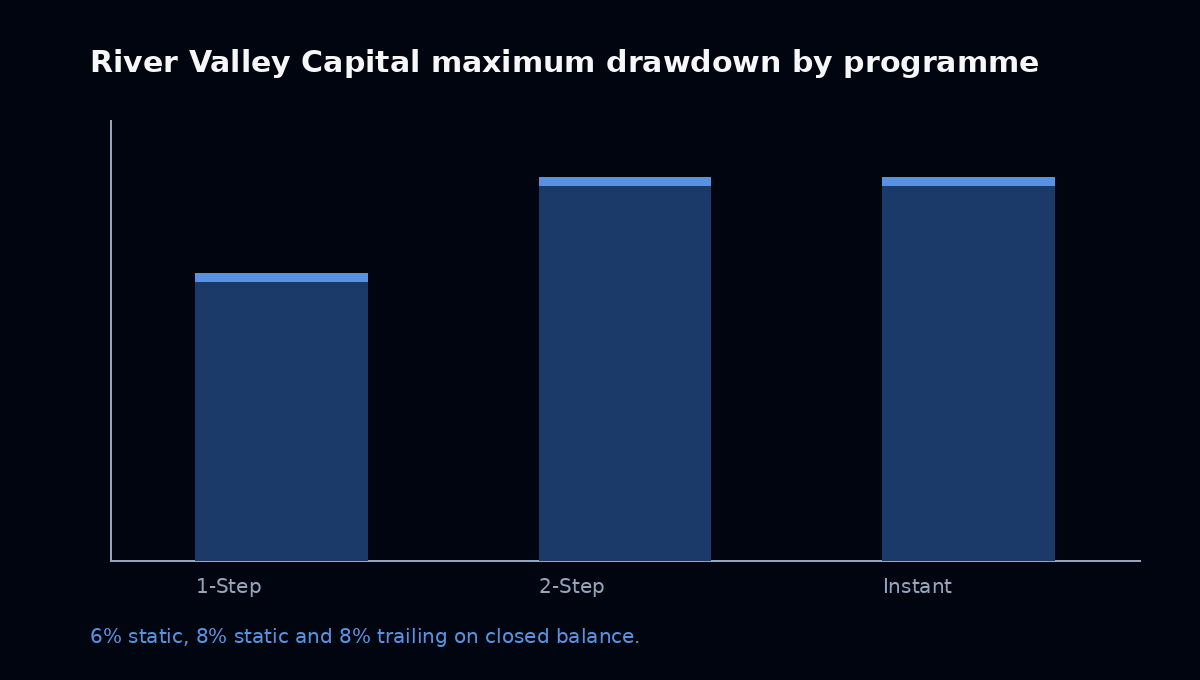
River Valley Capital uses different drawdown models depending on the account type:
- 1-Step: 6% static maximum drawdown.
- 2-Step: 8% static maximum drawdown.
- Instant Funding: 8% trailing maximum drawdown based on closed balance.
FTMO also varies its maximum-loss rules by programme:
- 1-Step: 10% end-of-day balance trailing maximum loss.
- 2-Step: 10% static maximum loss.
- Instant: 10% intraday balance trailing maximum loss.
The difference between static and trailing drawdown matters.
A static loss floor does not automatically move upward when an evaluation account makes a profit.
A trailing loss floor can increase as the account reaches new balance highs, reducing the distance between the current account value and the permitted floor. Our trailing drawdown guide works through the arithmetic.
River Valley Capital's 1-Step and 2-Step evaluations offer static drawdown, while its Instant account uses a trailing model.
One additional difference is that River Valley Capital does not apply consistency rules across its programmes.
Traders should still review the daily loss limits, payout-related drawdown-lock conditions and prohibited trading practices before purchasing. The full trading rules page sets them out.
Challenge Fees, Account Sizes and Profit Splits
Pricing is another important consideration when comparing River Valley Capital and FTMO.
River Valley Capital currently advertises the following starting account fees:
| Programme | Starting account size | Starting fee |
|---|---|---|
| 1-Step | $5,000 | $59 |
| 2-Step | $5,000 | $49 |
| Instant Funding | $5,000 | $199 |
River Valley Capital offers 1-Step accounts up to $400,000, 2-Step accounts up to $500,000 and Instant Funding accounts up to $100,000.
FTMO advertises 1-Step challenges starting from EUR 79, 2-Step challenges starting from EUR 89 and Instant accounts starting from EUR 169.
These starting prices are not directly comparable without matching account sizes and currencies.
One difference worth considering is fee reimbursement.
River Valley Capital's challenge and add-on purchases are non-refundable.
FTMO offers conditional reimbursement of the 2-Step evaluation fee with a qualifying reward withdrawal.
For profit sharing, River Valley Capital provides an 80% standard split across its programmes, with the option to increase it to 90% through an add-on.
FTMO offers different reward conditions depending on the selected programme, with a 90% reward ratio on its 1-Step and Instant options and up to 90% on 2-Step.
To compare the actual value of an account, look beyond the starting fee. Consider the account size, evaluation requirements, loss limits, profit-sharing conditions and the complete purchase cost. View River Valley Capital account sizes and fees.
Which Prop Firm Should You Choose?
Consider River Valley Capital If You:
- Prefer a 5% daily loss limit across all programmes.
- Want no consistency rule.
- Prefer an 8% Phase 1 target on a 2-Step Challenge.
- Want no minimum trading days.
- Prefer static drawdown on a 1-Step or 2-Step evaluation.
- Want to compare evaluation and Instant Funding options.
Consider FTMO If You:
- Prefer a larger initial maximum-loss allowance on certain programmes.
- Value its conditional 2-Step fee reimbursement.
- Prefer a 90% standard reward ratio on 1-Step or Instant accounts.
- Are comfortable with applicable consistency and minimum trading-day conditions.
- Prefer FTMO's specific trading platforms or programme structure.
Both providers offer different ways to participate in simulated prop trading.
Rather than choosing solely on the advertised account size or profit split, compare the requirements that could affect your ability to complete the programme and remain within its rules.
Final Verdict: River Valley Capital or FTMO?
River Valley Capital offers several advantages for traders who prefer simpler consistency requirements, a higher daily loss allowance on 1-Step and Instant accounts, a lower first-phase target on 2-Step and no minimum trading days.
FTMO remains a strong alternative for traders who prefer its larger initial maximum-loss allowances, programme-specific reward conditions or conditional fee reimbursement.
For traders whose strategies align with River Valley Capital's published risk rules, it offers an option worth exploring.
Before purchasing, review the current account sizes, programme conditions and complete fees to make sure the selected evaluation fits your approach.
Both firms provide simulated trading programmes. River Valley Capital is not a brokerage service, and simulated account allocations should not be interpreted as deposits of live trading capital. Evaluation success and reward eligibility depend on the provider's terms. This comparison is for informational purposes and is not financial advice.