By The River Valley Capital Team ·

River Valley Capital vs FTMO 1-Step: Quick Comparison
| Feature | River Valley Capital | FTMO |
|---|---|---|
| Evaluation phases | 1 | 1 |
| Profit target | 10% | 10% |
| Daily loss limit | 5% | 3% |
| Maximum drawdown | 6% static | 10% trailing, end-of-day balance |
| Consistency rule | None | 50% |
| Minimum trading days | None | None |
| Time limit | Unlimited | Unlimited |
| Standard profit split | 80% | 90% |
| Starting challenge fee | $59 | EUR 79 |
Based on published standard conditions reviewed in November 2026. Fees, currencies and programme terms may change.
River Valley Capital's 1-Step Challenge offers a 5% daily loss limit, 6% static evaluation drawdown and no numerical consistency requirement.
Where the Two 1-Step Challenges Differ
Daily Loss Limit: River Valley Capital Offers More Flexibility
One of the clearest differences is the maximum daily loss allowance.
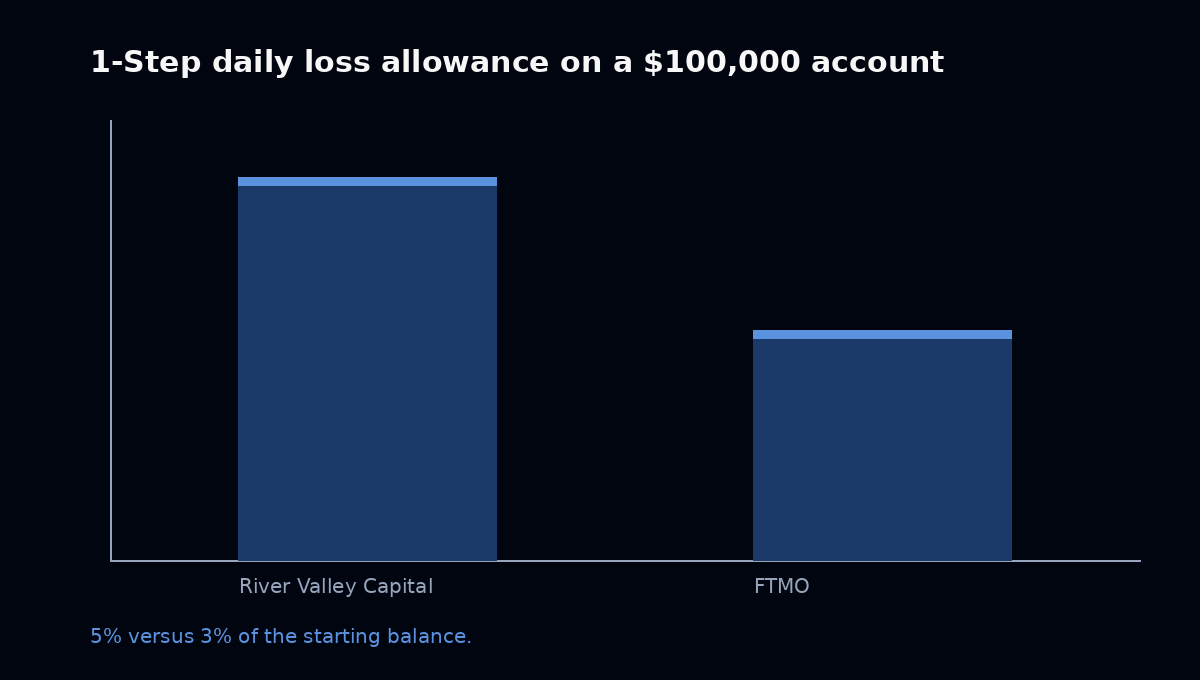
River Valley Capital's 1-Step Challenge has a 5% daily loss limit, compared with 3% at FTMO.
For example, on a $100,000 simulated account, the initial allowances are:
- River Valley Capital: $5,000
- FTMO: $3,000
That gives River Valley Capital traders a larger permitted daily loss allowance under the initial calculation.
The two firms also use different daily reset times and calculation methods, so these starting amounts should not be treated as fixed limits that remain unchanged every day. River Valley Capital works its daily level out from the greater of the previous day's closing balance or your equity at the 5:00 PM New York reset.
A higher limit does not necessarily mean a trader should take more risk. It does, however, provide additional flexibility within the programme's stated rules.
Static vs Trailing Drawdown: An Important Difference
River Valley Capital uses a 6% static maximum drawdown on its 1-Step Challenge.
FTMO uses a 10% trailing maximum-loss limit based on end-of-day balance.
What does that mean?
On a $100,000 River Valley Capital evaluation, the static drawdown floor starts at $94,000 and does not rise simply because the account grows.
At FTMO, the maximum-loss floor initially starts at $90,000. However, it can move upward according to the programme's trailing calculation.
FTMO therefore offers a larger initial maximum-loss allowance, while River Valley Capital offers a static evaluation floor that is easier to track. Our guide to trailing drawdown explains how a moving floor behaves in practice.
For traders who prefer knowing that their overall drawdown floor will not automatically rise after profitable days, River Valley Capital's model may be appealing.
This $94,000 static drawdown example applies to River Valley Capital's 1-Step evaluation before any funded-account payout. On the funded account, the maximum drawdown floor moves to the starting balance when a payout request is approved, unless the trader has purchased the Remove Lock on Payout add-on.
Traders should review both the evaluation rules and the funded-account payout conditions before choosing a programme.
No Consistency Rule at River Valley Capital
River Valley Capital does not apply a consistency rule to its 1-Step evaluation.
FTMO applies a 50% consistency requirement to 1-Step accounts purchased under its updated rules from 12 October 2026. Accounts purchased before the change may remain subject to the previous Best Day Rule.
Under the updated rule, a trader's most profitable day must not exceed 50% of the total cumulative profit required by FTMO's consistency calculation.
For example, imagine making $6,000 on your best trading day and $10,000 in total profit.
Your best day accounts for 60% of your profits.
At FTMO, you would need to continue trading until you met the consistency condition. Exceeding the threshold does not automatically close the account.
River Valley Capital does not impose this additional requirement, and the same is true across its three programmes. See prop firms with no consistency rule for the wider picture.
This may matter to traders whose strategies produce large profits on relatively few trading days.
Both Challenges Have the Same 10% Profit Target
Both firms require traders to reach a 10% profit target during the 1-Step evaluation.
On a $100,000 simulated account, that equals $10,000.
Neither programme has a fixed minimum number of trading days or a maximum evaluation period under its published standard conditions.
The main differences are therefore not how many evaluation stages or days are required, but the risk and consistency conditions traders must satisfy. River Valley Capital sets out all of them on its trading rules page.
Challenge Fees and Profit Splits
River Valley Capital's 1-Step Challenge starts at $59, with the actual fee depending on the selected account size.
FTMO's 1-Step Challenge starts at EUR 79.
These starting prices are in different currencies and should not be interpreted as a direct like-for-like account-size comparison.
River Valley Capital offers a standard 80% profit split, with an optional add-on increasing the share to 90%.
FTMO advertises a 90% reward ratio for its 1-Step programme.
When comparing costs, check the same simulated account size, available platforms, add-ons and applicable purchase terms. You can view River Valley Capital account sizes and fees for every programme.
Which 1-Step Challenge Should You Choose?
Consider River Valley Capital If You:
- Prefer a 5% rather than 3% daily loss limit.
- Want a static maximum drawdown during evaluation.
- Do not want a consistency requirement.
- Prefer one of River Valley Capital's available trading platforms.
- Want to evaluate its published account-size and fee options.
Consider FTMO If You:
- Prefer a larger initial maximum-loss allowance.
- Are comfortable managing a trailing loss floor.
- Can satisfy the applicable consistency requirement.
- Prefer its standard 90% reward ratio.
- Find its programme and platform conditions better suited to your strategy.
The best choice depends on how you trade and which requirements you can consistently follow.
Final Verdict: River Valley Capital or FTMO 1-Step?
If your priority is a higher daily loss allowance, static evaluation drawdown and no consistency requirement, River Valley Capital offers a combination worth considering.
FTMO provides a larger initial maximum-loss allowance and a higher standard reward ratio, but its trailing drawdown and consistency conditions require careful consideration.
Before choosing, review the exact account rules and costs. You can also read the full River Valley Capital vs FTMO comparison or the 2-Step comparison.
Both programmes involve simulated trading. Evaluation success and reward eligibility depend on programme conditions. This comparison is informational and does not constitute financial advice.