By The River Valley Capital Team ·

River Valley Capital vs FTMO 2-Step: Quick Comparison
| Feature | River Valley Capital | FTMO |
|---|---|---|
| Evaluation phases | 2 | 2 |
| Phase 1 profit target | 8% | 10% |
| Phase 2 profit target | 5% | 5% |
| Daily loss limit | 5% | 5% |
| Maximum drawdown | 8% static | 10% static |
| Minimum trading days | None | 4 per phase |
| Time limit | Unlimited | Unlimited |
| Standard profit split | 80%, or 90% with add-on | 80%, up to 90% under applicable terms |
| Starting challenge fee | $49 | EUR 89 |
| Challenge fee refundable | No | Yes, subject to conditions |
Based on published conditions reviewed in November 2026. Fees, currencies, promotions and programme rules may change.
River Valley Capital's 2-Step Challenge offers an 8% first-phase profit target, 5% daily loss limit and 8% static evaluation drawdown.
Where the Two 2-Step Challenges Differ
Phase 1 Profit Target: River Valley Capital Requires 8% Instead of 10%
One of the biggest differences between these two challenges is the first evaluation target.
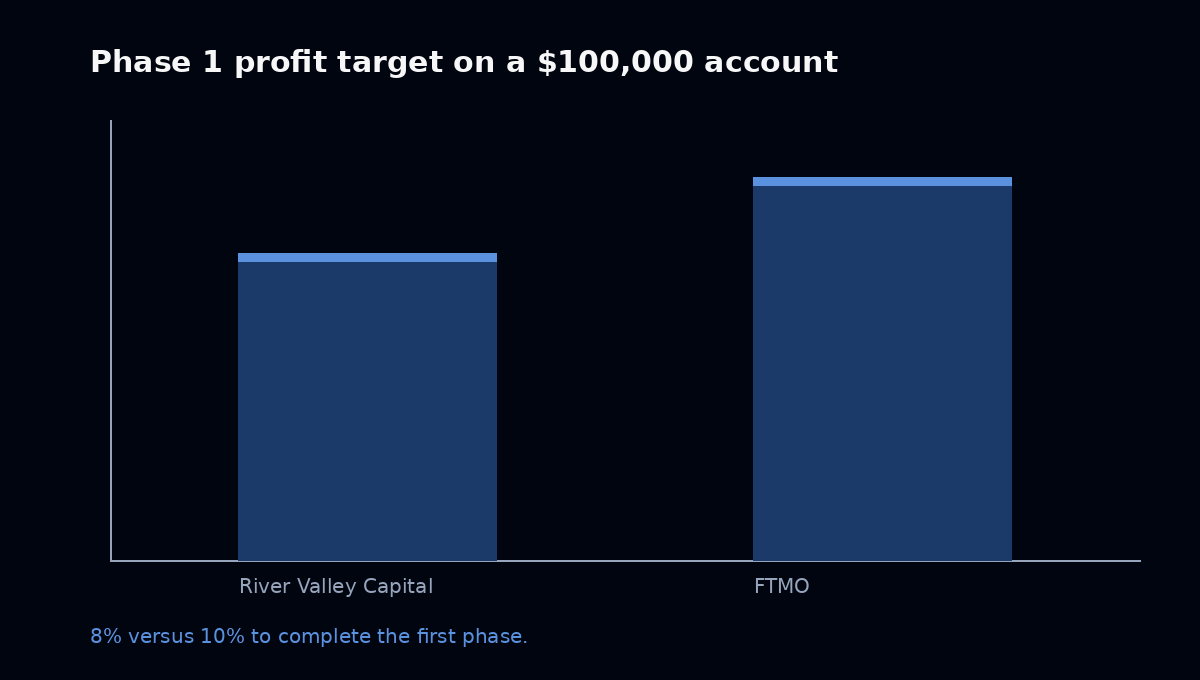
River Valley Capital's 2-Step Challenge requires an 8% profit target in Phase 1, compared with 10% at FTMO.
For example, on a $100,000 simulated account:
- River Valley Capital Phase 1 target: $8,000
- FTMO Phase 1 target: $10,000
That is a $2,000 difference in the profit required to complete the first evaluation phase.
Both firms then require 5% in Phase 2, equivalent to $5,000 on a $100,000 simulated account.
For traders who prefer working toward smaller individual evaluation targets, River Valley Capital offers a more accessible first-phase objective in percentage terms.
However, a lower target does not automatically guarantee an easier evaluation. Traders must still manage their positions within the daily and overall loss limits.
Minimum Trading Days: River Valley Capital Has No Requirement
Another significant difference is how many days traders must trade before completing each evaluation phase.
River Valley Capital does not impose a minimum number of trading days on its 2-Step Challenge.
FTMO requires at least four trading days in Phase 1 and four trading days in Phase 2.
For FTMO, a trading day is a calendar day in Central European time during which at least one position is opened. Keeping an existing position open across several days does not automatically count as multiple trading days.
Consider a trader who reaches the required profit target in two trading days.
At River Valley Capital, there is no additional minimum trading-day condition preventing the trader from completing that phase, provided all other requirements are satisfied.
At FTMO, the trader must still complete the required four trading days for that phase.
This gives River Valley Capital an advantage for traders who prefer fewer mandatory trading sessions.
Both programmes have unlimited evaluation periods, although other rules, including inactivity requirements, may still apply.
Maximum Drawdown: 8% Static vs 10% Static
Maximum drawdown determines how far an account can fall before breaching the programme's overall loss limit.
River Valley Capital uses an 8% static maximum drawdown for its 2-Step Challenge.
FTMO uses a 10% static maximum-loss limit for its 2-Step Challenge.
On a $100,000 simulated account, the initial overall loss floors are:
- River Valley Capital: $92,000
- FTMO: $90,000
Both are static during the standard evaluation, meaning the overall loss floor does not automatically increase simply because the trader makes a profit.
For River Valley Capital, the $92,000 static floor example applies during the evaluation. On the funded account, the drawdown floor moves to the starting balance when a payout request is approved, unless the trader has purchased the Remove Lock on Payout add-on.
FTMO provides a larger overall loss allowance: 10% compared with River Valley Capital's 8%.
However, River Valley Capital requires a lower Phase 1 profit target, so traders should evaluate the relationship between the target and the maximum permitted loss.
For a $100,000 account, River Valley Capital requires $8,000 to meet Phase 1 while allowing $8,000 in maximum overall loss. FTMO requires $10,000 to meet Phase 1 while allowing $10,000 in maximum overall loss.
Neither programme should be judged by drawdown percentage alone. Your trading strategy, average position risk and ability to manage losing periods matter more. The drawdown calculator works your floor out in dollars.
Daily Loss Limit: Both Firms Allow 5%
Unlike the differences in profit targets and minimum trading days, both firms publish a 5% daily loss limit for their 2-Step challenges.
On a $100,000 starting simulated account, that corresponds to an initial daily loss allowance of $5,000.
However, the daily loss calculation and reset time differ between the providers.
River Valley Capital calculates its daily loss threshold using the higher of the previous day's closing balance or equity at the 5:00 PM New York reset.
FTMO uses its published daily-loss calculation with a midnight Central European time reset.
That means traders should not assume that a 5% limit operates identically throughout the trading day at both firms.
Open positions, commissions and the applicable daily reference values can affect how much room remains before a breach.
For traders holding positions across daily resets, reviewing the exact trading rules is particularly important.
Challenge Fees and Profit Splits
River Valley Capital's 2-Step Challenge starts at $49 for a $5,000 simulated account, with fees increasing according to the selected account size.
For example, a $100,000 2-Step Challenge is listed at $519.
FTMO's 2-Step Challenge starts at EUR 89 for its $10,000 account option, while a $100,000 account is currently advertised from EUR 439 under the displayed pricing offer.
These are different currencies and account configurations, so the advertised starting fees should not be treated as a direct like-for-like comparison.
One important distinction is the refund policy.
River Valley Capital's challenge purchase fees are non-refundable.
FTMO offers reimbursement of its 2-Step challenge fee with the first qualifying reward withdrawal, subject to its terms.
For profit sharing, River Valley Capital offers an 80% standard split, with an optional add-on increasing it to 90%.
FTMO offers an 80% standard reward share, with the possibility of increasing it to 90% under applicable conditions.
Before purchasing, compare the actual challenge fee, optional add-ons, payout rules and total cost for your chosen account size on the accounts page.
Which 2-Step Challenge Should You Choose?
Consider River Valley Capital If You:
- Prefer a lower Phase 1 profit target of 8% rather than 10%.
- Want no minimum trading-day requirements.
- Prefer a static maximum drawdown during evaluation.
- Want a 5% daily loss limit.
- Prefer one of River Valley Capital's available trading platforms.
Consider FTMO If You:
- Prefer a larger 10% overall maximum-loss allowance.
- Are comfortable with the 10% Phase 1 profit target.
- Can complete four minimum trading days per evaluation phase.
- Value the qualifying challenge-fee refund.
- Prefer FTMO's available platforms or evaluation structure.
The better choice depends on which set of rules aligns with your strategy and trading goals.
Final Verdict: River Valley Capital or FTMO 2-Step?
If your priority is a lower Phase 1 profit target, no minimum trading days and a straightforward static evaluation drawdown, River Valley Capital offers a compelling alternative to FTMO's 2-Step Challenge.
FTMO provides a wider overall maximum-loss allowance and qualifying fee reimbursement, which may appeal to traders who prioritise those conditions.
For traders who prefer fewer mandatory sessions and an 8% first-phase target, River Valley Capital is worth considering.
Before making a purchase, compare the current account sizes, rules and fees to ensure the programme suits your trading strategy. You can also read the full River Valley Capital vs FTMO comparison or the 1-Step comparison.
River Valley Capital and FTMO offer simulated trading programmes. Evaluation completion, account progression and reward eligibility are subject to each provider's rules. This article is informational and does not constitute financial advice.