By The River Valley Capital Team ·

Prop Firms With Static Drawdown: Quick Comparison
The table below covers evaluation programmes that use a static maximum drawdown, meaning the overall loss floor is set from the starting balance and does not move up as you profit.
| Prop firm | Programme | Daily loss limit | Maximum drawdown | Minimum trading days |
|---|---|---|---|---|
| River Valley Capital | 1-Step | 5% | 6% static | None |
| River Valley Capital | 2-Step | 5% | 8% static | None |
| FTMO | 2-Step | 5% | 10% static | 4 per phase |
| FundedNext | Stellar 1-Step | 3% | 6% static | 2 |
| FundedNext | Stellar 2-Step | 5% | 10% static | 5 per phase |
| FXIFY | 2-Phase Pro | 4% | 8% static | 3 profitable days per phase |
Competitor figures were read on 19 November 2026 from each firm's own published rules: FTMO's trading objectives, FundedNext's trading objectives and FXIFY's 2-Phase Pro programme rules. Programme terms change, so check the firm's current rules before you buy.
Every programme above uses a static floor during evaluation, but that is where the similarity ends.
FTMO and FundedNext allow the widest overall loss on their 2-Step programmes at 10%. River Valley Capital allows 6% on its 1-Step and 8% on its 2-Step.
The difference that does not show up in a drawdown column is time. River Valley Capital asks for no minimum trading days on either programme. Every other programme in the table asks for somewhere between two days and three separately profitable days before you can finish.
A wider loss allowance is not the same as an easier evaluation. Read the daily limit, the profit target and the trading-day requirement together.
What Static Drawdown Means in Practice
Static drawdown sets one fixed account value that you must stay above. It is calculated from your starting balance and it does not move during the evaluation.
Take a $100,000 account with a 10% static maximum drawdown. The maximum permitted loss is $10,000, so the floor sits at $90,000. If you trade the account up to $105,000, the floor is still $90,000. Your buffer has grown from $10,000 to $15,000 purely because the floor stayed put.
A trailing floor behaves differently. It follows the account upward using the firm's own formula, so profit raises the level you must stay above and your buffer stays roughly constant.
| Static drawdown | Trailing drawdown | |
|---|---|---|
| Initial floor | Set from the starting balance | Set by the programme's formula |
| Moves up after profit | No | Yes |
| Buffer as you profit | Grows | Stays about the same |
| After a payout | Depends on the firm's rules | Depends on the firm's rules |
Neither model is better in the abstract. A trailing programme often grants a larger headline allowance. A static programme gives you one number to manage and rewards you for being ahead.
If you want the mechanics in full, read what drawdown means in trading and how trailing drawdown is calculated.
River Valley Capital's Static Drawdown Programmes
River Valley Capital runs two evaluations with static maximum drawdown: the 1-Step and the 2-Step Challenge. Both carry a 5% daily loss limit, no minimum trading days, no evaluation deadline and no numerical consistency rule. They differ on the profit target and on how much overall loss they allow.
1-Step Challenge: 6% Static
One evaluation phase, a 10% profit target and a 6% static maximum drawdown. On a $100,000 account the floor sits at $94,000 and stays there however well the evaluation goes.
The trade-off is plain: the tightest floor of the three programmes, in exchange for only having to pass once. It suits traders who would rather clear one hurdle than two.
2-Step Challenge: 8% Static
Two phases, with an 8% target in Phase 1 and 5% in Phase 2, and an 8% static maximum drawdown. On a $100,000 account the floor sits at $92,000.
You get $2,000 more room than the 1-Step on the same account size, and smaller targets in each phase, at the cost of passing twice. Neither phase has a minimum trading-day requirement.
Instant Funding Is Not a Static Programme
This one matters if you are shopping specifically for static drawdown. River Valley Capital's Instant Funding account uses an 8% trailing maximum drawdown calculated on closed balance, not a static floor.
Do not assume all three programmes share a drawdown model because they share a daily loss limit. The full conditions are on the trading rules page.
How FTMO, FundedNext and FXIFY Compare
FTMO 2-Step: 10% Static
FTMO's 2-Step Challenge publishes a 10% static maximum loss and a 5% maximum daily loss, with a 10% profit target in the Challenge phase and 5% in Verification. FTMO describes the rule as establishing "a static limit", set at the initial capital minus 10%, and it requires at least four trading days in each phase (FTMO trading objectives, read 19 November 2026).
On a $100,000 evaluation that is a $90,000 floor, wider than either River Valley Capital programme. The counterweight is eight trading days across the two phases before you can finish, against none at River Valley Capital.
Note that this applies to FTMO's 2-Step only. FTMO's 1-Step uses an end-of-day trailing limit and a 3% daily loss, so it does not belong in a static-drawdown comparison at all.
FundedNext Stellar: Two Static Options
FundedNext publishes static maximum loss on both Stellar evaluation programmes, which makes it the most direct structural comparison in this list.
| Stellar 1-Step | Stellar 2-Step | |
|---|---|---|
| Maximum loss | 6% static | 10% static |
| Daily loss limit | 3% | 5% |
| Profit target | 10% | 8% then 5% |
| Minimum trading days | 2 | 5 per phase |
Stellar 1-Step matches River Valley Capital's 1-Step on the 6% static floor, but halves the daily allowance to 3% and asks for two trading days. Stellar 2-Step gives the widest floor here alongside FTMO, and asks for the most time: five days in each phase.
FundedNext's Stellar Instant programme uses a 6% trailing floor, so it is outside this comparison (FundedNext trading objectives, read 19 November 2026).
FXIFY: Check the Variant, Not the Brand
FXIFY runs several 2-Phase programmes and they do not share a drawdown model, so the firm name alone tells you nothing.
Its 2-Phase Pro publishes an 8% maximum loss, a 4% daily loss limit and a static drawdown type, with FXIFY stating that the maximum loss level "is fixed at the start of the evaluation and remains unchanged". Its 2-Phase Standard is trailing and locks at breakeven. Its 2-Phase Classic is listed as static, but FXIFY does not publish a maximum-loss percentage for that variant on the pages we checked, which is why no figure for it appears in the table above.
Two further Pro conditions are easy to miss. The three minimum trading days are three profitable days: FXIFY requires the account to close each of them at least 0.5% up. And a $4,000 daily profit cap applies, above which the account goes read-only for the rest of the day. Classic separately carries a 25% consistency rule at the funded stage (FXIFY 2-Phase Pro rules, read 19 November 2026).
River Valley Capital applies no numerical consistency rule and no profitable-day requirement on any programme.
What a Static Floor Looks Like on $100,000
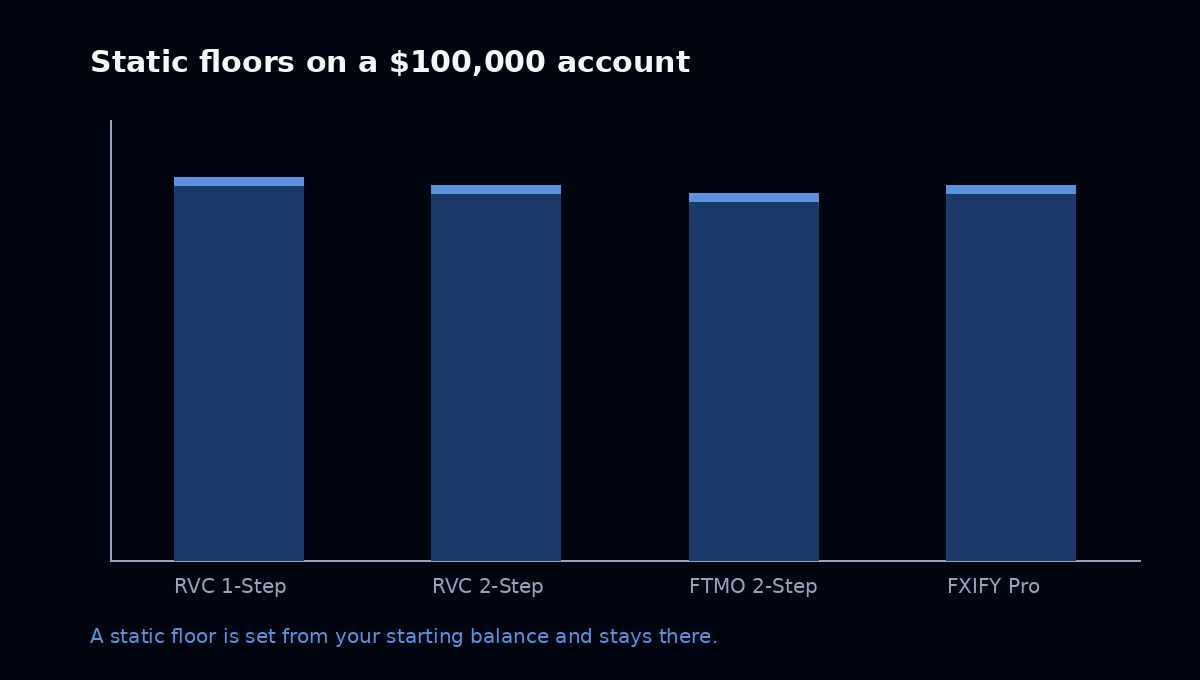
Percentages flatten out the real differences. Here is the same comparison as account values on a $100,000 evaluation.
| Programme | Static maximum drawdown | Initial loss floor |
|---|---|---|
| River Valley Capital 1-Step | 6% | $94,000 |
| River Valley Capital 2-Step | 8% | $92,000 |
| FTMO 2-Step | 10% | $90,000 |
| FundedNext Stellar 1-Step | 6% | $94,000 |
| FundedNext Stellar 2-Step | 10% | $90,000 |
| FXIFY 2-Phase Pro | 8% | $92,000 |
These are evaluation-stage floors only. They sit alongside each programme's daily loss limit, which you can breach without ever approaching the overall floor.
What Happens to a Static Floor After a Payout
A static floor during evaluation does not mean a permanently fixed floor. At River Valley Capital, once a funded-account payout is approved, the maximum drawdown floor moves up to the account's starting balance unless you hold the Remove Lock on Payout add-on.
In practice: a $100,000 2-Step account starts with a $92,000 floor. After an approved payout the floor becomes $100,000 under the standard terms. Withdraw everything and you have no buffer at all, which is why withdrawing the full eligible amount is rarely the right call.
The prop firm calculator shows what you receive and the withdrawal that leaves a buffer intact. Other firms set their own post-payout conditions, so check them rather than assuming evaluation rules carry over.
How to Choose Between Static Drawdown Programmes
Read the Daily Limit Next to the Overall Floor
The overall floor decides how long you survive a bad run. The daily limit decides how much you can risk in one session. FundedNext's Stellar 1-Step shows why both matter: it matches River Valley Capital's 6% static floor but allows only 3% in a day instead of 5%.
Count the Days You Must Trade
A minimum trading-day rule sets a floor on how long the evaluation takes, no matter how fast you hit the target. Four days per phase at FTMO means eight days minimum. River Valley Capital's 1-Step and 2-Step have no such requirement, though that is not a promise any evaluation can be finished in a day.
Look for Consistency and Profitable-Day Conditions
These do the same job as a minimum-day rule by another route. A best-day percentage, a profitable-day threshold or a daily profit cap all constrain how quickly you can qualify. River Valley Capital applies no numerical consistency rule, though the prohibited trading practices still apply. See prop firms with no consistency rule for how these are calculated.
Check What Happens After You Pass
Profit split, payout frequency, minimum withdrawal and any post-payout drawdown change all affect what the account is worth to you. A static evaluation floor says nothing about the funded stage.
The right programme is the one whose whole rule set fits how you trade, not the one with the biggest drawdown number.